Trees of knowledge and writing as a layperson
How does knowledge grow?
When I write my thoughts out, I have a voice that tells me that someone's already written about this, but better — better researched, more thought out, from someone who has spent more time in the particular field of whatever I'm thinking about. I ask myself: Who am I to write about this? I get discouraged and many ideas die at this stage.
This self-sabotaging thought comes from spending a lot of time in my niche professional field, Quaternary geology — a subfield of geology focusing on the last ~2.58 million years (largely characterized by cycles of glacial and interglacial stages). As I've gained experience in this very specific branch of science, I've realized that the branching doesn't stop there. The branch of Quaternary geology splits into smaller and smaller twigs, Quaternary geochronology, glacial geomorphology, Quaternary stratigraphy, ice sheet modelling, till dispersal and provenance, etc[1]. I wouldn't even call myself an expert on the study area I based my Master's thesis on — there are still too many questions I don't know the answer to.
My journey along the Dunning-Kruger curve for Quaternary geology affected how I looked at other interests that I want to explore. If I want to write about a thought I had related to philosophy, or ecology, or psychology, is some surface-level exploration enough? How can I write well while being ignorant to the vast body of research in a particular field? To continue with the tree analogy, how am I to know enough about a branch while ignorant to the roots, the trunk, and the rest of the branches in the crown? If it took me 6 years of post-secondary education to learn about just one branch, how could I swing over to a completely different tree?
I realize this is probably an ego problem. Does something have to be unique to be put out into the world? Does it have to be the best version? Even as I write this purely from my own experience, I'm tempted to look up if others have felt the same (they probably have), and if anyone's written about it.
I think of the quote:
"All intelligent thoughts have already been thought; what is necessary is only to try to think them again." — Johann Wolfgang von Goethe
Originally, I didn't get this quote and rejected the premise; it would be extremely disheartening to learn that the few worthwhile thoughts I have are interchangeable with another's. Would it not follow that I, the individual, am replaceable? But my focus has been on the first part and neglects the second[2]. The second part reminds us that what's necessary is to reach good, intelligent thought on our own, to internalize it, and then to apply it to the present problems in our lives, our communities, our societies. The wisest thinkers and writers of the past have no agency on the present. Clearly the individual is, therefore, indispensable.
So maybe I'm thinking about my trees wrong?
In the forest of all human knowledge, I have imagined myself to be an arborist, attempting to learn and study the natural architecture and find a good spot to attach and graft my own little branch.
However, my tree analogy is off, as the totality of human knowledge is not a forest; it is not organic. It does not grow continuously as a tree does. Indeed, our collective knowledge is held within humans, who die and are born, and do not inherently pass down knowledge to future generations; instead, our spoken and written word is what keeps the flame alive. Therefore, human knowledge is less like a forest and maybe is more similar to a library, made up of instalments added incrementally throughout history and safeguarded by civil society.
What does grow organically is the totality of an individual's knowledge. Given enough time and effort, we grow from knowing just our biological imperatives to learning more about ourselves, our interests, the people around us, and our place in the world.
In this way, the individual's knowledge can be compared to a tree:
-
The roots: representing one's interests and consumption of experiences
- Experiences [nutrients] are probed for, extracted, and digested (via reflection) from both one's life and the media one consumes [soil]
- Serves as the foundation for growth and binds the worldview [trunk] to the world
- Largely imperceptible to others
-
The trunk: representing one's evolving thought and worldview
- Shows as the strength and resilience of one's knowledge system to outside forces gained through growth
- The worldview [trunk] may suffer [rot] without digesting experiences and outward expression [growing root and shoot systems]
- The worldview changes through periods of growth and stagnation throughout one's life [seasonal growth rings]
- Growth is imperceptible to others, yet the constitution of the worldview can be tested and interacted with
-
The crown: representing one's outward expression to others
- One must express themselves to others (linguistically, artistically, or physically) to receive social energy [sunlight]
- Outward expressions come in different forms [leaves, flowers, fruit] and grow in different directions [branches] yet are all based on one's thoughts [trunk]
- Obvious to others, and the primary focal point of growth
Some implications naturally follow from this analogy:
- The trunk does not grow without growing other parts at the same time. New branches and new root systems are imperative to growth. Therefore, one must simultaneously metabolise their experience with the world and outwardly express themselves to others for growth
- The root system and the branch system must both be allowed to naturally grow in their environment; a pot-bound plant is neither strong nor able to develop further, likewise for topiary pruning. Therefore, one must allow their interests to develop and spread while refraining from pruning seemingly uncharacteristic outward expressions
From these, I can convince myself that writing (or other creative pursuits) is positive for growth, even if one is not the best or the most well-researched. By growing, one might even be able to reach new heights and shoot off in new directions never before seen. Even if intelligent thoughts are not new, the world in which we grow our roots is never the same, and therefore each of our outward expressions are unique as well. So, I think I'll say no to pruning for a while... twisted trees are much less boring anyway...
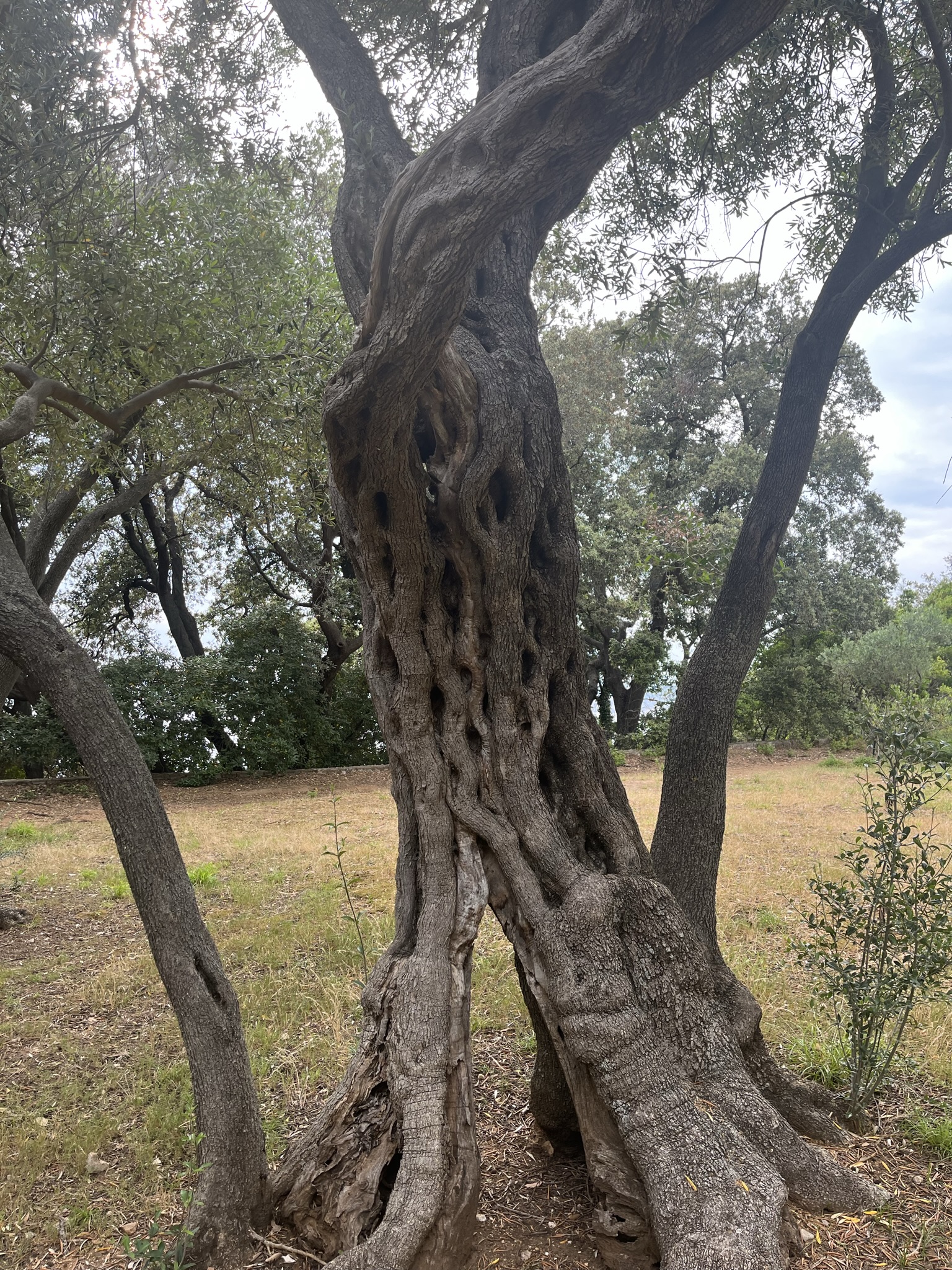
A twisty olive tree in the Historical Gardens
of Lokrum island, Croatia, June 2023.
P.S. Right after writing this, I stumbled across this book: The Tree of Knowledge. I stg if they wrote what I just wrote but better I'll be PISSED
[1] Some twigs are shared between branches, also, like Quaternary paleoecology, which is paleoecology (the study of ancient ecologies) applied to the Quaternary period. Tiny fossils (pollen, bugs) are collected from interglacial deposits and analyzed to answer questions like, "was the Arctic tree line different during different interglacial stages?" or "how did ecosystems react to times of rapid climate change?".
[2] On the internet, it is usually shortened to just the first part, often giving a despondent tone.